Think about the last time you searched for something online. Did you type your question into Google, or did you ask an AI assistant like ChatGPT or Perplexity? If you’re like many people in 2026, you’ve probably done both.
Search is no longer limited to scrolling through pages of blue links. Today, people expect instant, accurate answers, and AI-powered search tools are changing how information is discovered. At the same time, Google remains the world’s most trusted search engine, constantly improving its experience with AI-powered features.
So, AI Search vs Google Search—which one is really leading the future of search?
The truth is, there isn’t a single winner. Each platform solves different problems, and understanding those differences can help businesses, marketers, and website owners stay ahead. Let’s explore how search has evolved and what it means for your online strategy in 2026.
AI Search vs Google Search: What’s the Real Difference?
Although both help users find information, they work in completely different ways.
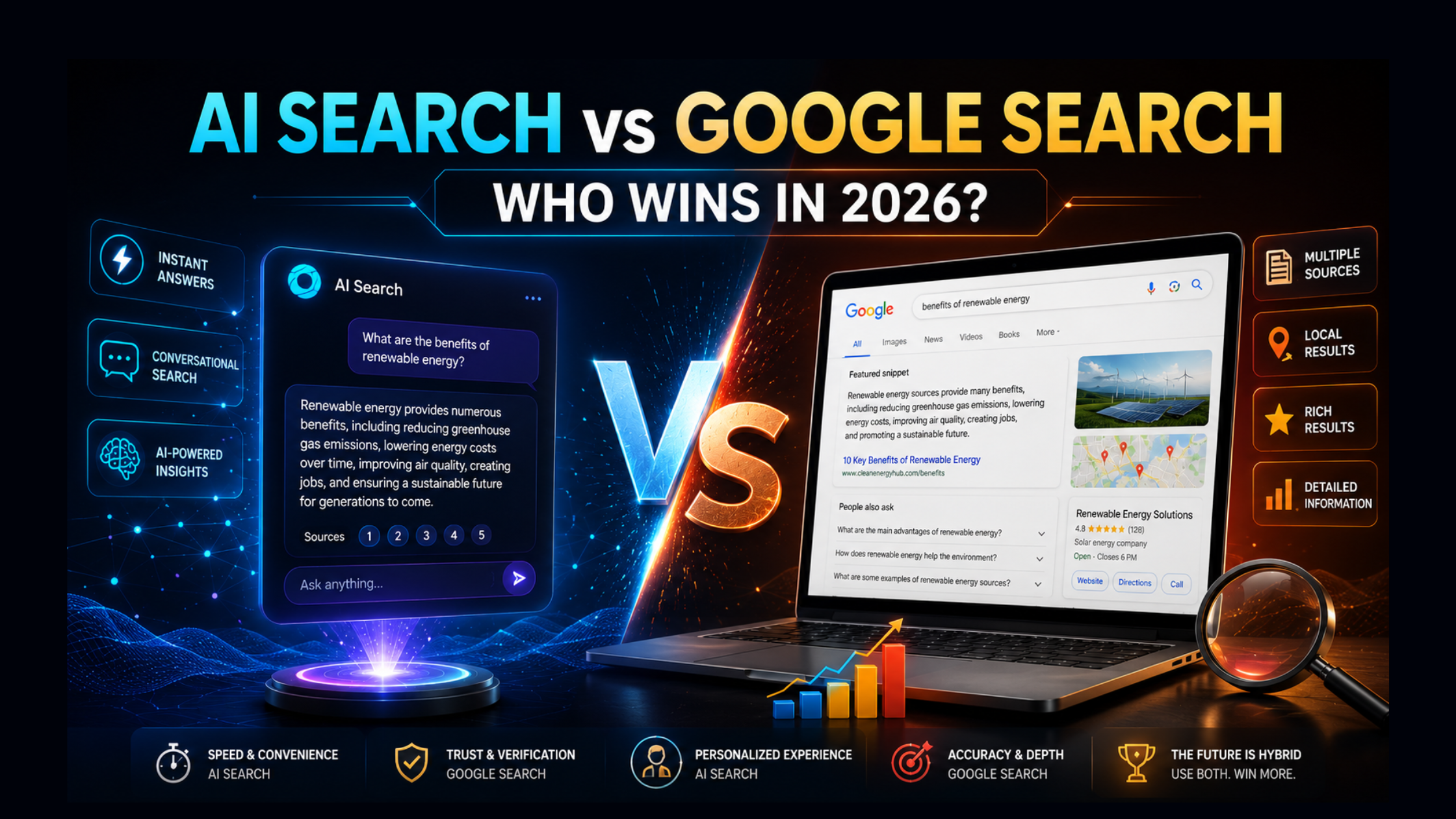
Google Search is designed to help people discover websites. It scans billions of web pages, ranks them based on relevance and quality, and lets users decide which source to trust. Whether you’re researching a product, reading reviews, or comparing services, Google gives you plenty of options.
AI search takes a different approach. Instead of offering a list of websites, it reads information from multiple sources and delivers a direct answer in a conversational style. You ask a question just as you would ask another person, and the AI responds with a summary that saves you time.
For quick explanations or simple research, AI search feels incredibly convenient. But when users need detailed information or want to verify facts, Google often remains the preferred choice.
Why AI Search Is Becoming So Popular
One reason AI search is growing so quickly is simple—it removes extra steps.
Imagine you’re looking for the best project management software. Instead of opening ten different websites and comparing features yourself, an AI assistant can summarize everything in seconds. It highlights key differences, explains the pros and cons, and even suggests which option might fit your needs.
This faster experience is exactly what today’s users expect.
Students use AI to understand difficult topics, professionals rely on it for research, and marketers use it to brainstorm ideas and analyze trends. As AI continues to improve, more people are turning to conversational search before opening a traditional search engine.
Why Google Still Matters
Despite all the excitement around AI, Google isn’t going anywhere.
In fact, Google has adapted remarkably well. Its search results now include AI-generated summaries, featured snippets, local business listings, videos, product recommendations, and much more.
What makes Google especially valuable is trust.
Instead of asking users to accept one answer, Google provides access to multiple sources. This allows people to compare opinions, verify information, and dive deeper into topics that interest them.
For businesses, Google continues to be one of the most important channels for attracting long-term organic traffic. A well-optimized website can bring visitors for months or even years without ongoing advertising costs.
How AI Search vs Google Search Is Changing SEO
SEO isn’t disappearing—it’s simply evolving.
A few years ago, ranking on Google was mostly about keywords and backlinks. While those factors still matter, search engines and AI systems now place much greater importance on content quality, expertise, and user experience.
Businesses should focus on creating content that genuinely answers users’ questions instead of publishing articles filled with keywords.
Clear headings, useful examples, original insights, and easy-to-read formatting make content more valuable for both Google and AI-powered search tools.
The websites that perform best in 2026 are those that prioritize people first and algorithms second.
Which Search Experience Is Better?
The answer depends entirely on what you’re trying to accomplish.
If you want a quick explanation, AI search is usually the fastest option. It delivers concise answers almost instantly and makes follow-up questions feel natural.
However, if you’re making an important decision—such as choosing financial software, comparing healthcare providers, or researching legal information—you’ll probably want to explore multiple trusted sources. That’s where Google continues to shine.
Rather than replacing each other, AI search and Google search complement one another.
Many users now begin their journey with AI and finish it with Google, especially when they need more detailed information.
What Businesses Should Do in 2026
Businesses shouldn’t choose between AI search and Google search—they should prepare for both.
Start by publishing original, high-quality content that demonstrates expertise. Share real experiences, practical advice, case studies, and solutions to common customer problems.
Next, make your content easy to understand. Use descriptive headings, answer common questions, and organize information clearly. This improves readability for human visitors while also helping AI systems interpret your content accurately.
Finally, focus on building trust. Reviews, authoritative backlinks, updated information, and a fast, mobile-friendly website remain essential for long-term success.
The brands that succeed in 2026 will be those that create genuinely helpful content rather than simply chasing search algorithms.
Final Thoughts
The debate over AI Search vs Google Search doesn’t have a simple winner.
AI search is changing how people find answers by making research faster and more conversational. Google continues to dominate website discovery, local search, shopping, and in-depth research. Both platforms are shaping the future of search in different ways.
Instead of asking which one will replace the other, businesses should ask a better question: How can we be visible on both?
The answer lies in creating trustworthy, people-first content that provides real value. Whether someone discovers your business through Google or an AI assistant, quality information will always stand out.