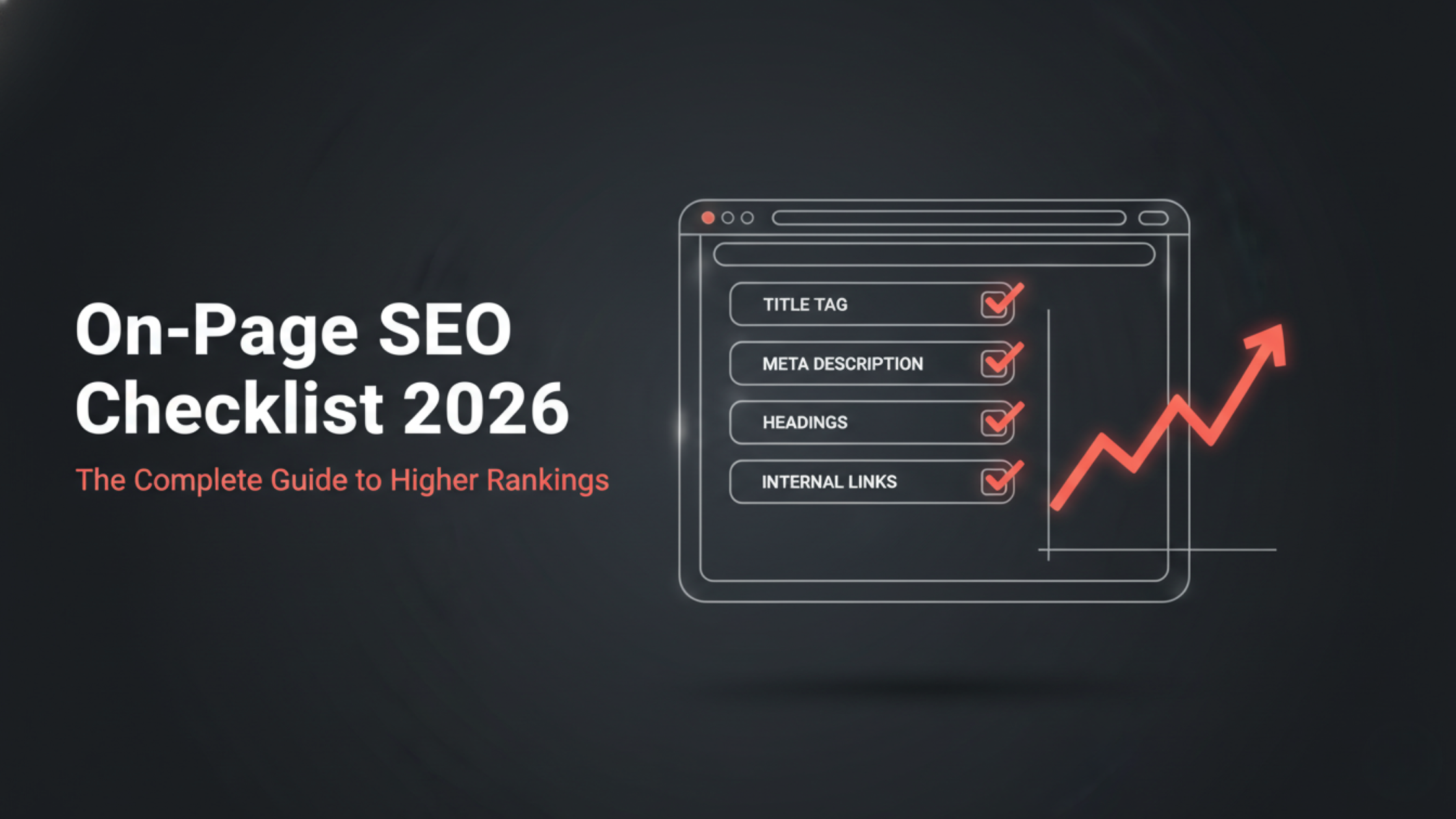
If you want your website to rank on Google in 2026, on-page SEO is non-negotiable.
Search engines are smarter than ever. With AI-driven algorithms like Google’s advanced ranking systems, simply stuffing keywords into your content no longer works. Instead, Google now rewards valuable, user-focused, structured, and technically optimized content.
So if your pages are stuck on page 2 (or worse), this guide will walk you through a complete On-Page SEO Checklist for 2026 — step by step.
Let’s dive in.
1. Start with Smart Keyword Research
Before you write a single word, you need the right keyword.
In 2026, keyword research isn’t just about search volume. It’s about:
- Search intent (informational, transactional, navigational)
- Keyword difficulty
- Content depth required
- Related long-tail variations
Use tools like:
- SEMrush
- Ahrefs
- Ubersuggest
Pro Tip:
Target one primary keyword and 5–10 related semantic keywords. Google now understands context, not just exact-match phrases.
2. Optimize Your Title Tag (Without Clickbait)
Your title tag is still one of the strongest ranking factors.
Best Practices for 2026:
- Keep it under 60 characters
- Include your primary keyword naturally
- Add a benefit or number
- Make it compelling but not misleading
Example:
❌ On-Page SEO Guide
✅ On-Page SEO Checklist for 2026: 15 Steps to Rank Higher
A strong title improves both rankings and click-through rate (CTR).
3. Write a Magnetic Meta Description
Meta descriptions don’t directly impact rankings — but they influence clicks.
Best practices:
- 140–160 characters
- Include primary keyword
- Add a clear benefit
- Use action-oriented language
Think of it as your mini ad in search results.
4. Use Proper URL Structure
Your URL should be:
✔ Short
✔ Clean
✔ Keyword-rich
✔ Free from numbers and symbols
Example:
❌ yoursite.com/blog/post-2026-article-123
✅ yoursite.com/on-page-seo-checklist-2026
Short URLs rank better and look more trustworthy.
5. Structure Content with SEO-Friendly Headings
Search engines use headings to understand content structure.
Follow This Hierarchy:
- H1 → Main title (only one)
- H2 → Main sections
- H3 → Subtopics
- H4 → Supporting details
Your headings should:
- Include related keywords
- Be clear and descriptive
- Improve readability
Well-structured content keeps users engaged longer — which improves SEO signals.
6. Focus on Search Intent (Critical in 2026)
This is where most websites fail.
Before writing, ask:
- What does the user want?
- A guide?
- A comparison?
- A step-by-step tutorial?
If someone searches “On-Page SEO Checklist,” they want:
✔ Clear steps
✔ Actionable advice
✔ Practical examples
Not vague theory.
Match intent = higher rankings.
. Optimize for Semantic SEO (Top 2026 Trend)
Google uses AI models to understand context.
Instead of repeating the same keyword, include related terms like:
- On-page optimization
- SEO best practices
- Internal linking
- Content optimization
- Technical improvements
This improves topical authority.
8. Write High-Quality, Long-Form Content
In competitive niches, 600–800 words is not enough.
For strong rankings in 2026:
- 1200–2000+ words
- Deep explanations
- Examples
- FAQs
- Action steps
Google rewards comprehensive content that fully answers a topic
9. Optimize Images Properly
Image SEO is underrated.
Checklist:
✔ Compress images (fast loading)
✔ Use descriptive file names
✔ Add keyword-rich alt text
✔ Use modern formats (WebP)
Example alt text:
“On-page SEO checklist infographic for 2026”
Fast-loading pages rank better.
10. Improve Page Speed (Major Ranking Factor)
Page speed directly affects:
- Rankings
- Bounce rate
- User experience
- Conversions
Use tools like:
- Google PageSpeed Insights
- GTmetrix
Aim for:
✔ Load time under 3 seconds
✔ Core Web Vitals in green
✔ Optimized mobile performance
11. Internal Linking Strategy
Internal links help:
- Distribute authority
- Improve crawlability
- Increase time on site
- Boost rankings
Best practices:
- Link to 3–5 related articles
- Use descriptive anchor text
- Avoid over-optimization
Think of your website like a web — every page should connect logically.
12. Add FAQ Section (Boosts Visibility)
FAQs increase:
- Content depth
- Featured snippet chances
- User engagement
- Voice search visibility
Example FAQs:
Q: How many keywords should I use per page?
Focus on one primary keyword and multiple related terms naturally.
Q: Is content length important in 2026?
Yes — depth and relevance matter more than pure word count.

13. Optimize for Mobile-First Indexing
Search engines now evaluate your website primarily through its mobile version. In other words, if your site doesn’t perform well on a smartphone, your rankings will reflect it — even if the desktop version looks perfect.
Mobile-first indexing means your mobile experience is no longer optional. It’s the standard.
To ensure your pages are properly optimized:
- Use a fully responsive design that adapts smoothly to all screen sizes
- Choose readable font sizes and adequate spacing for smaller screens
- Avoid intrusive popups that block content or frustrate users
- Optimize images and scripts to ensure fast mobile loading
- Keep buttons large enough and navigation easy to use
A poor mobile experience increases bounce rates, reduces engagement, and sends negative quality signals to search engines.
In 2026, user experience and SEO go hand in hand. If your site feels smooth and effortless on mobile, you’re already ahead of many competitors.
14. Strengthen E-E-A-T Signals
In 2026, rankings are no longer driven by keywords alone. Search engines evaluate who is behind the content and whether the information can be trusted.
E-E-A-T stands for:
- Experience – Have you actually worked with what you’re talking about?
- Expertise – Do you demonstrate real knowledge in your field?
- Authoritativeness – Is your site recognized as a credible source?
- Trust – Can users rely on your information?
For competitive niches like SEO, digital marketing, finance, or health, these signals are critical.
To strengthen E-E-A-T on your website:
- Add a clear author bio that highlights real-world experience
- Link to professional social profiles such as LinkedIn
- Reference credible sources when mentioning data or studies
- Keep your content updated and accurate
- Display transparent contact information and policies
When users trust your content, search engines are more likely to trust it too.
E-E-A-T isn’t a shortcut tactic — it’s a long-term credibility strategy. And in 2026, credibility is a ranking advantage.
15. Update Old Content Regularly
Fresh content isn’t just about publishing new articles — it’s about maintaining the quality of what you’ve already published.
Search engines favor pages that stay relevant. If your content includes outdated statistics, old screenshots, or obsolete strategies, rankings can slowly decline — even if the article once performed well.
Make it a habit to review important pages every 6–12 months.
During each update:
- Refresh outdated statistics and data
- Improve formatting and readability
- Add new examples or case insights
- Replace old screenshots with current ones
- Strengthen internal linking to newer articles
- Expand sections that feel thin or incomplete
Often, updating an existing article produces faster ranking improvements than publishing a brand-new one. It signals to search engines that your content is actively maintained and trustworthy.
Consistency is what builds long-term authority.
Bonus: On-Page SEO Mistakes to Avoid in 2026
Even strong websites lose rankings because of avoidable on-page mistakes. As algorithms become more sophisticated, small issues can quietly hold your pages back. Here are the most common ones to eliminate:
❌ Keyword Stuffing
Forcing your primary keyword into every paragraph doesn’t help anymore — it harms readability and signals low-quality content. In 2026, Google understands context. Write naturally, and use related terms where they fit organically.
❌ Thin 600-Word Posts
Surface-level content rarely ranks in competitive niches. If your article doesn’t fully answer the user’s query, someone else’s will. Depth, clarity, and usefulness matter more than hitting a minimum word count.
❌ Duplicate Meta Titles
When multiple pages share similar titles, search engines struggle to understand which one to prioritize. Every page should have a unique, clearly defined purpose — and a distinct title to match.
❌ Slow Page Speed
A slow website frustrates users and increases bounce rates. Even great content won’t perform well if the page takes too long to load. Optimize images, reduce unnecessary scripts, and monitor performance regularly.
❌ No Internal Linking Strategy
Publishing content without linking related articles is a missed opportunity. Internal links guide users, distribute authority, and help search engines crawl your site more efficiently.
❌ Ignoring Search Intent
This is the biggest mistake of all. If your content doesn’t match what the user actually wants — whether it’s a guide, comparison, or tutorial — rankings will suffer, no matter how optimized the page appears.
On-page SEO isn’t about doing more — it’s about doing the right things consistently and avoiding these common pitfalls.
Fix these issues, and you’ll notice steady, sustainable ranking improvements over time.
Final On-Page SEO Checklist Summary
If you want your content to rank consistently in 2026, focus on getting the fundamentals right. Here’s your practical action checklist:
- Do proper keyword research based on intent, not just volume
- Write compelling, optimized title tags and meta descriptions
- Keep URLs short, clean, and meaningful
- Structure content clearly with proper headings (H1, H2, H3)
- Align every page with clear search intent
- Use related and semantic keywords naturally
- Create in-depth, high-quality content (not surface-level posts)
- Optimize images for speed and relevance
- Improve page loading speed and Core Web Vitals
- Build smart internal linking between related articles
- Add helpful FAQ sections where relevant
- Ensure mobile-first responsiveness
- Strengthen trust with real author details and credibility signals
- Update old content regularly to keep it fresh and accurate
On-page SEO isn’t about tricks anymore. It’s about clarity, depth, and genuine value.
If you apply these principles consistently, your website won’t just rank for 2026 — it will build long-term authority that survives future algorithm updates.