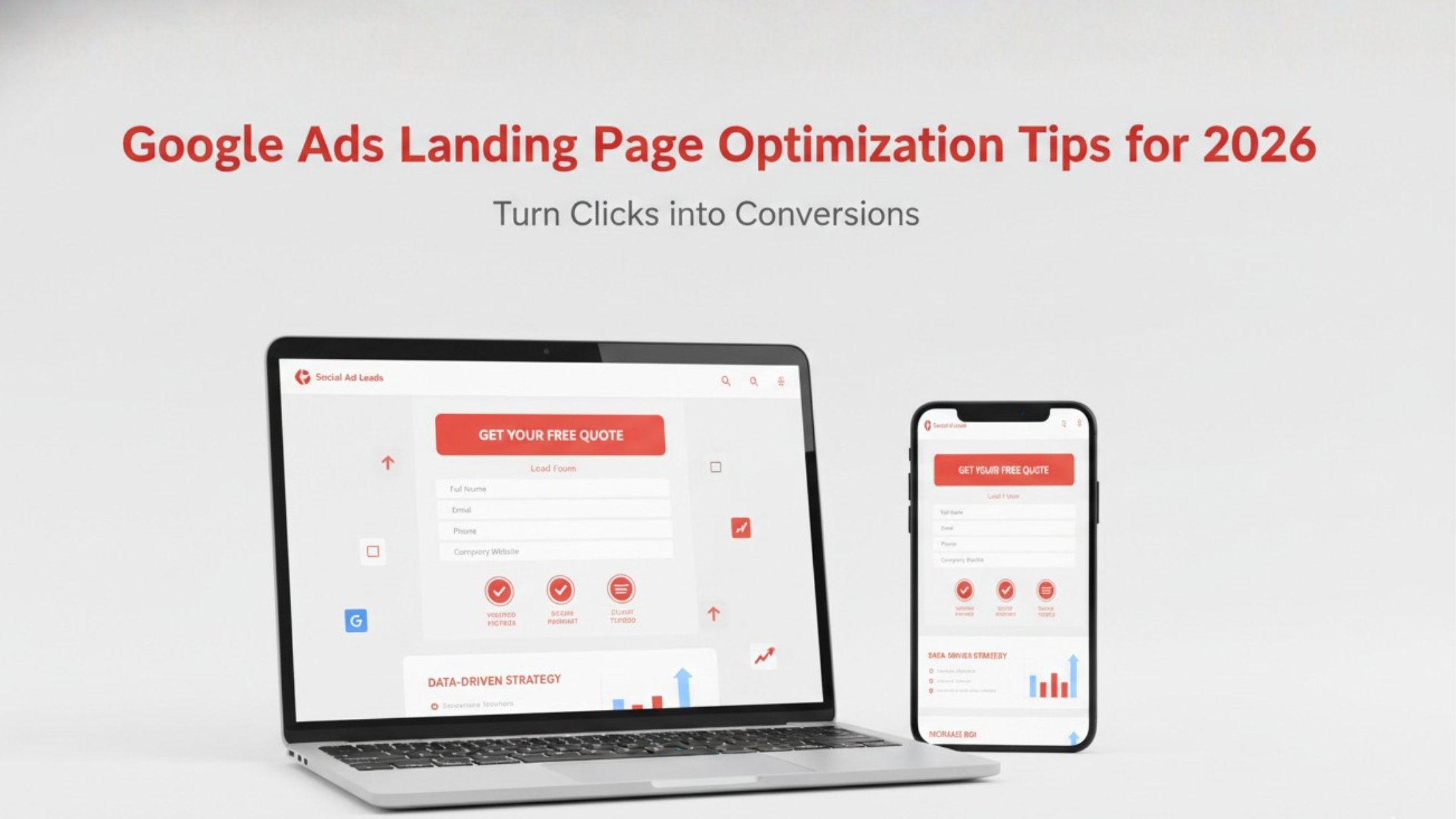
In 2026, managing Google Ads involves more than just selecting the appropriate keywords and making wise bids. The landing page of your campaign is the actual battleground for conversions with AI-driven campaigns, more intelligent users, and higher CPCs.
If your landing page doesn’t convert, you can have flawless ads and still lose money.
We’ll dissect useful, tried-and-true Google Ads landing page optimization ideas for 2026 in this post. These tactics are in line with Google’s most recent algorithms, user behavior patterns, and conversion psychology.
This blog will assist business owners, marketers, and agencies in converting more clicks into leads and sales.
Why Landing Page Optimization Matters More Than Ever in 2026
In 2026, Google Ads heavily evaluates landing page experience as part of Ad Rank and Quality Score. That means:
- Poor landing pages = higher CPC
- Low relevance = fewer impressions
- Bad UX = wasted ad spend
Today’s users expect:
- Instant clarity
- Lightning-fast load speeds
- Zero confusion
- Total trust
If your landing page fails in the first 5 seconds, your conversion is gone.
Google Ads Landing Page Optimization Tips for 2026 (Core Principles)
Let’s get into the most important optimization principles that actually move the needle.
1. Match Ad Intent with Laser-Focused Messaging
Your landing page must continue the exact promise of the ad—not introduce something new.
Best practices:
- Repeat your main keyword in the headline
- Mirror ad language (offers, pain points, benefits)
- Avoid generic homepages for paid traffic
👉 Example:
If your ad says “Google Ads Management for Small Businesses”, your landing page headline should not say “Welcome to Our Digital Marketing Agency.”
Relevance = higher Quality Score + lower CPC.
High-converting landing pages in 2026 adhere to the single-goal guideline.
❌ Things not to do:
Multiple CTAs
Top menus for navigating
External references
✅ How to proceed:
One main call to action (call, form, or WhatsApp)
Unambiguous visual hierarchy
Copy that is specific and motivates a single action
2. One Goal. One Page. Zero Distractions.
In 2026, high-converting landing pages follow a single-goal rule.
❌ What to avoid:
- Multiple CTAs
- Top navigation menus
- External links
✅ What to do:
- One primary CTA (Call / Form / WhatsApp)
- Clear visual hierarchy
- Focused copy that drives one action
The moment users have choices, conversions drop.
3. Speed Is Non-Negotiable (Especially for Mobile)
In 2026, however, mobile devices will account for the majority of Google Ads traffic. You are wasting money if it takes longer than three seconds for your page to load.
Tips for optimizing speed:
Make use of bright themes
Compress pictures
Turn on caching
Steer clear of complex animations
Make use of quick hosting
Google rewards quick sites with reduced expenses and more ad visibility.
4. Mobile-First Design Is Mandatory
Your landing page should be designed for thumb scrolling, not desktop screens.
Checklist for mobile optimization:
Big, readable text
CTA buttons that stick
brief paragraphs (no more than two or three lines)
Simple forms to tap
Buttons that click to make calls
Users will quickly jump if they have to zoom close or find it difficult to read.
5. Craft Headlines That Speak Benefits, Not Features
In 2026, attention spans are shorter than ever. Your headline must answer one question instantly:
👉 “What’s in it for me?”
High-converting headline formulas:
- “Get [Result] Without [Pain Point]”
- “Increase [Benefit] in [Timeframe]”
- “Trusted by [Audience Type] Across [Location]”
Follow the headline with a supporting subheadline that builds clarity and trust.

6. Use Trust Signals That Reduce Fear
Users clicking Google Ads are cautious. They’re evaluating credibility in seconds.
Trust elements that work in 2026:
- Google reviews & ratings
- Client logos
- Testimonials with photos
- Certifications (Google Partner, ISO, etc.)
- Clear contact details
- Privacy & data assurance statements
Trust removes friction. Less friction = more conversions.
7. Forms: Shorter, Smarter, Intent-Based
Long forms kill conversions—especially for cold traffic.
Best practices:
- Ask only essential fields
- Use intent-based forms (Name, Phone, Email)
- Add micro-copy (“We never spam”)
- Place form above the fold for lead-gen pages
For high-ticket services, you can use multi-step forms to improve completion rates.
8. Strong CTA Copy That Demands Action
In 2026, generic CTAs like “Submit” don’t cut it.
High-performing CTA examples:
- “Get Free Consultation”
- “Book a Strategy Call”
- “Check Eligibility Now”
- “Get Pricing Instantly”
Your CTA should feel valuable, urgent, and benefit-driven.
9. Align Landing Pages with Conversion Tracking
Your landing page must be built with conversion tracking in mind.
Ensure:
- GA4 events are properly set
- Google Ads conversion tags fire correctly
- Thank-you pages or success events are tracked
- Call tracking is enabled for phone leads
No tracking = no optimization = no scalability.
10. Continuous A/B Testing Is the Real Growth Lever
The best landing pages in 2026 are never final.
Test:
- Headlines
- CTAs
- Button colors
- Form length
- Social proof placement
Even small changes can improve conversion rates by 20–50% over time.
Common Landing Page Mistakes to Avoid in 2026
Avoid these costly errors:
- Sending paid traffic to blog pages
- Overloading pages with information
- Ignoring mobile UX
- Weak or unclear CTA
- No trust elements
- No conversion tracking
Each mistake directly impacts your ad spend and ROI.
Final Thoughts: Landing Pages Decide Google Ads Success in 2026
In 2026, Google Ads success is no longer ad-first—it’s landing-page-first.
You can outbid competitors, but you can’t out-convert them without:
- Relevance
- Speed
- Clarity
- Trust
- Strong CTAs
Master these Google Ads landing page optimization tips for 2026, and your campaigns will become more profitable, scalable, and predictable.