Running Google Ads is easy.
Running Google Ads profitably—that’s where the real challenge begins.
If your campaigns are not structured properly, you will face problems like:
- Wasted budget
- Irrelevant clicks
- Low conversions
- Poor Quality Scores
- Difficulty scaling
But when you learn how to structure Google Ads campaigns like a pro, everything changes. You get more control, better targeting, higher ROI, and cleaner data that helps you make smarter decisions.
In this guide, you’ll learn exactly how experts structure Google Ads campaigns for maximum performance and long-term scalability.
1. Start With a Clear Campaign Goal (Your Foundation)
Before creating any campaign, decide the primary objective. This determines your bidding, keywords, ad copy, and placements.
Choose one clear goal per campaign:
- Lead Generation
- Website Traffic
- Sales / Conversions
- Brand Awareness
- App Installs
- Remarketing
Well-defined goals help you avoid mixed signals in Google’s algorithm and ensure your ads are optimized for the right outcomes.
2. Create a Clean Campaign Structure (Don’t Mix Everything Together)
One of the biggest mistakes beginners make is stuffing too many keywords, ads, and themes into a single campaign.
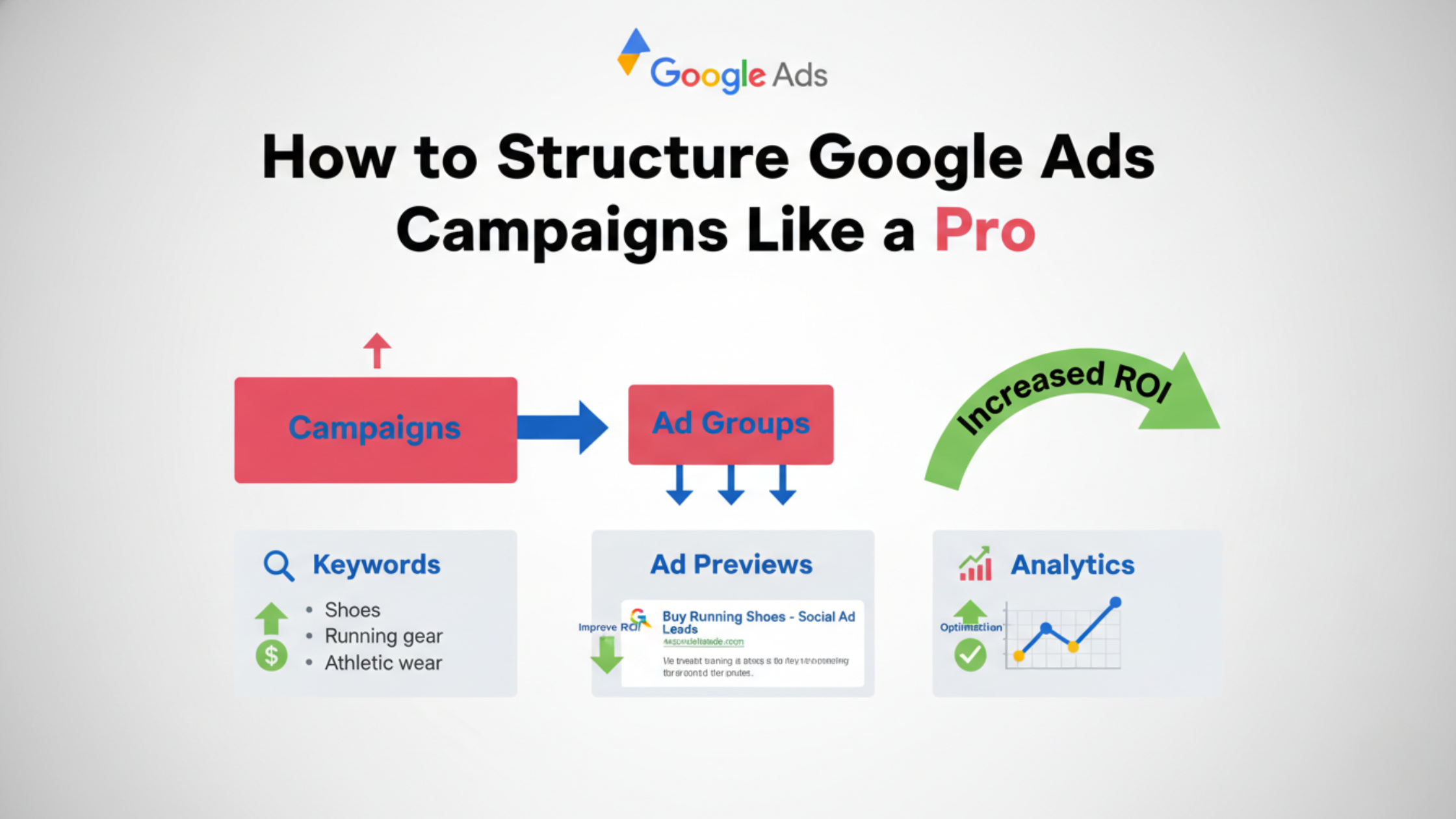
How pro advertisers structure campaigns:
- 1 campaign = 1 objective
- Multiple ad groups = Each with 1 tight theme
- Multiple ads per ad group for testing
- Negative keywords added at every level
This structure gives Google clear signals and enhances ad relevance, lowering CPC while improving conversions.
3. Use Tight Keyword Grouping for Maximum Relevance
Grouping keywords properly is essential for strong Quality Scores and high-performing ads.
Use the SKAG or STAG method:
- SKAG (Single Keyword Ad Group): Ultra-specific
- STAG (Single Theme Ad Group): Balanced + scalable
If your keyword is “digital marketing agency,” your ad group should include only variations like:
- digital marketing agency
- digital marketing agency near me
- best digital marketing agency
This tight structure improves ad relevance, boosting CTR and lowering costs.
4. Write High-Intent, High-Relevance Ad Copy
Your ad copy must clearly match your keyword theme. This significantly improves click-through rate and quality score.
Tips for pro-level ad copywriting:
✔ Include main keyword in the headline
✔ Address the searcher’s intent
✔ Provide unique value propositions
✔ Add trust signals (ratings, awards, years of experience)
✔ Use strong call-to-actions
Example for “Google Ads expert”:
Headline: Hire a Certified Google Ads Expert
Description: Get profitable campaigns, lower CPC & high-quality conversions.
5. Use Proper Negative Keyword Strategy (Avoid Wasted Spend)
Negative keywords are essential for cleaning up traffic and preventing irrelevant clicks.
Build 3 layers of negative lists:
- General negatives: free, jobs, course, tutorial
- Industry-specific negatives: based on your niche
- Campaign-specific negatives: pulled from search term reports
This keeps your campaign structure clean and eliminates low-intent searches.
6. Use Correct Match Types (Your Traffic Control System)
Google offers 3 keyword match types:
- Exact Match: Most precise
- Phrase Match: Balanced reach + control
- Broad Match: Maximum reach (use carefully)
Pro strategy:
- Use Exact for high-intent terms
- Use Phrase for scaled growth
- Use Broad only with strong first-party data or smart bidding
Match types are critical in structuring campaigns that deliver consistent results.
7. Build Strong Ad Groups With Multiple Ad Variations

Each ad group should contain:
- 3 Responsive Search Ads
- 1–2 extensions
- A/B test variations
This allows Google’s algorithm to learn faster and optimize for higher-performing ads.
Include:
- Sitelink extensions
- Callout extensions
- Structured snippets
- Phone extensions (if applicable)
- Price & promotion extensions
The more relevant extensions you use, the higher your ad rank becomes.
8. Create Dedicated Landing Pages (Turn Clicks Into Conversions)
Even a perfectly structured Google Ads campaign fails if the landing page doesn’t convert.
Your landing page must include:
✔ Relevant headline
✔ Keyword-focused content
✔ Fast loading speed
✔ Social proof or testimonials
✔ Strong call-to-action
✔ Minimal distractions
A landing page aligned with your ad group improves Quality Score and significantly boosts conversion rate.
9. Use Proper Bidding Strategies (Don’t Let Google Overspend)
Choosing the right bidding strategy is key to structuring a professional campaign.
Start here:
- Manual CPC / Enhanced CPC: Best for new campaigns
- Maximize Conversions: After receiving enough data
- Target CPA: When you’re getting stable conversions
- Target ROAS: Best for ecommerce scaling
Don’t use automated bidding until you have sufficient conversion data.
10. Track Everything (Data Is Your Real Power)
A pro Google Ads structure always includes:
- Conversion tracking
- Google Analytics data
- UTM parameters
- Call tracking
- Event tracking
This data helps you optimize your campaigns without guessing.
11. Add Remarketing Campaigns (Never Lose Interested Leads)
Remarketing ads help you bring back warm audiences who:
- Clicked your ads
- Visited your landing page
- Added items to cart
- Watched your videos
These campaigns typically have the highest ROI because the audience is already familiar with you.
12. Use a Multi-Campaign Setup to Scale Like a Pro
A professional Google Ads structure usually includes:
- Brand campaign
- Non-brand campaigns
- Competitor campaigns
- Remarketing campaigns
- Display campaigns
- YouTube campaigns (optional)
This allows for full-funnel scaling while maintaining clean data segmentation.
Final Thoughts
Structuring Google Ads campaigns like a pro isn’t about spending more—it’s about organizing your campaigns in a way that gives Google the clarity it needs to deliver maximum results.
With the right structure in place, you’ll experience:
✔ Higher Quality Scores
✔ Lower CPC
✔ Better ad relevance
✔ Higher conversion rates
✔ Easier scaling
✔ More profitable campaigns
Good structure = good performance.